
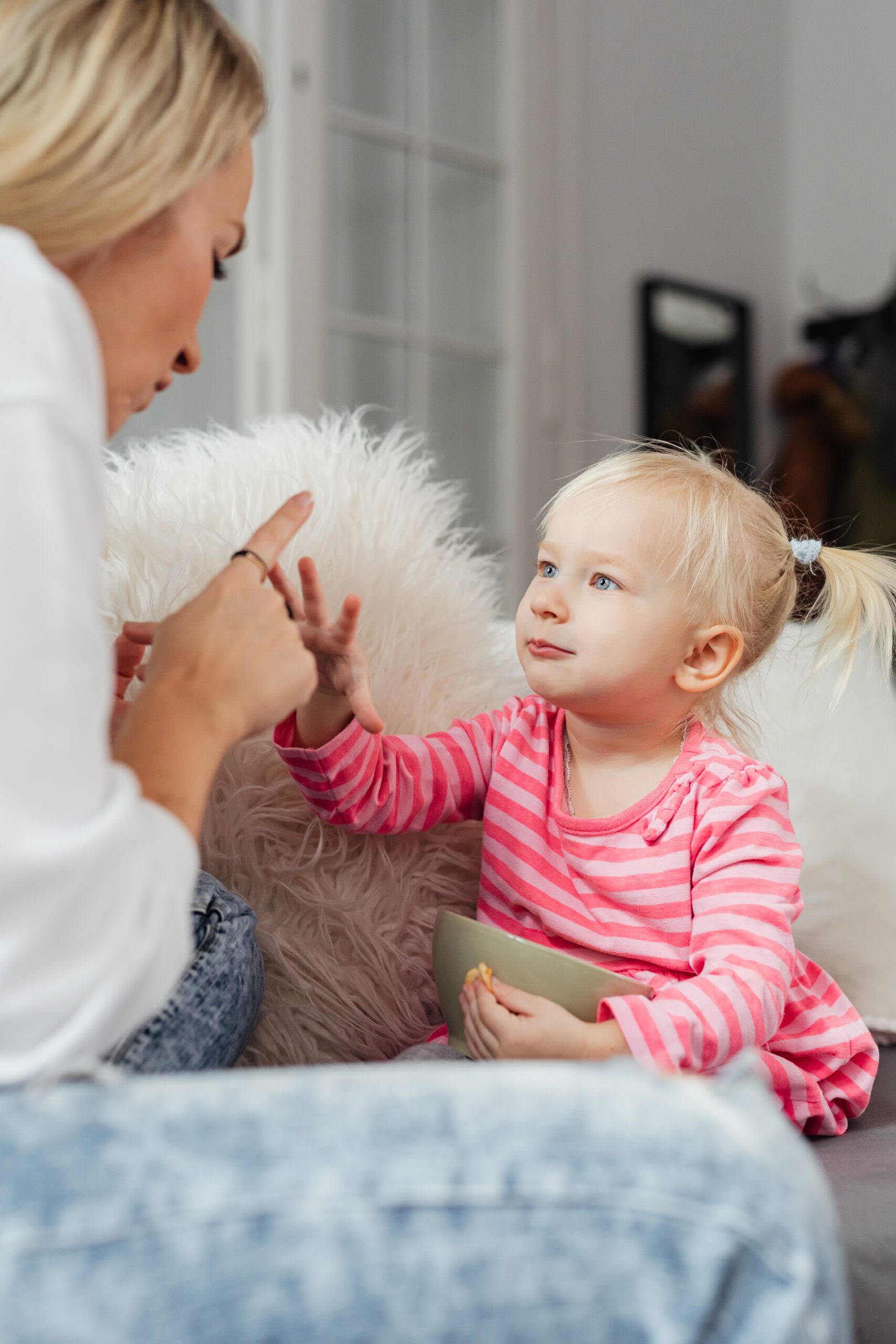
The first years of a child’s life are an extraordinary time for language development.
Long before babies can say their first words, they are listening. They are noticing sounds, rhythms, voices and patterns. Little by little, they begin to understand which sounds belong together, which words appear in familiar situations, and eventually how those words can be combined to communicate.
For children growing up with more than one language, the same process can happen across two — or even more — languages.
And one thing research consistently tells us is that experience matters.
The languages children hear, how often they hear them, who they hear them from, and how those languages are used in everyday life all contribute to the way their bilingual skills develop.
Recent research also suggests that it is not enough to think about bilingual exposure simply as a percentage of time spent hearing each language. A child’s language environment is much richer than that: it includes who is speaking, what is happening at the time, whether the child is actively engaged, and the gestures, actions, emotions and shared attention that accompany speech.
So if you would like French — or any other language — to become part of your child’s life, the early years are a wonderful time to start creating those experiences.
Babies Are Learning Language Before They Can Speak
Language learning does not begin with the first word.
Babies are already paying attention to speech from their earliest months. They listen to intonation, rhythm and individual speech sounds and gradually begin identifying patterns in the language around them.
This means that talking to a baby who cannot answer yet is far from pointless.
When you say:
On va au bain.
Tu veux ton doudou ?
Regarde le chien !
On met les chaussures.
your child may not repeat those sentences, but they are building familiarity with the sounds and structures of French.
Understanding usually develops before speaking does.
This distinction is particularly important when we talk about bilingual development. A 2025 longitudinal study by Heather Johnson and Erika Hoff followed bilingual children from age 2.5 to 12 and found that the relationship between the two languages was different for expressive vocabulary — the words children can say — and receptive vocabulary — the words they understand.
The researchers found evidence of a trade-off between the two languages in expressive vocabulary during the first few years, but not in receptive vocabulary. In other words, hearing two languages does not simply mean that one language is “taking space” away from the other in every aspect of development.
That is one reason we should be cautious about judging a young bilingual child only by the number of words they can say in one language.
Young Children Can Learn More Than One Language
A common concern among parents is that hearing two languages might confuse a young child.
Research does not support that idea.
Children are capable of learning two linguistic systems, and research has shown that infants exposed to two languages can distinguish between them from very early in development.
They may also use both languages in the same conversation as they grow. This is often called code-switching or language mixing, and it is not evidence that a child is confused.
A bilingual child might know one word in French and another in English, for example, and use whichever one is most accessible at that moment.
Their knowledge is being distributed across two languages.
And this is something researchers increasingly take into account when measuring bilingual vocabulary.
A 2024 study led by Krista Byers-Heinlein examined the vocabulary of 743 French- and English-learning infants and toddlers between 8 and 33 months. The researchers showed that the apparent difference between monolingual and bilingual children changed considerably depending on how vocabulary was measured.
When only one language was considered, bilingual children could appear to know fewer words. But when researchers considered vocabulary across both languages, the picture changed.
This is an important reminder for parents: a bilingual child’s language knowledge is not necessarily contained within one language.
Exposure Helps Build Each Language
A bilingual child’s two languages do not necessarily develop at exactly the same rate.
One of the clearest findings in bilingual language research is that children’s development in each language is related to the amount of experience they have with that language.
A child who hears mostly English and some French will therefore often develop English more quickly than French.
That does not mean the French exposure has failed.
It simply reflects the child’s linguistic environment.
A 2024 study of French-English monolingual and bilingual infants, led by Miranda Gómez Díaz and Laia Fibla in Krista Byers-Heinlein’s laboratory, followed vocabulary growth between 16 and 30 months.
The researchers found that, when looking at vocabulary within a particular language, children who had more exposure to that language tended to reach periods of rapid vocabulary growth earlier in that language.
In other words, exposure does not simply determine whether a child “knows” a language or not. It can influence the trajectory at which vocabulary develops.
But that does not mean parents need to calculate language percentages every day or create a perfectly balanced 50/50 environment.
Bilingual childhood rarely looks that neat.
The goal is to create frequent and meaningful opportunities for the child to hear and eventually use the language.
Not All Exposure Is the Same
It is tempting to think about language exposure in hours:
“How many hours of French does my baby hear?”
But young children do not experience language as a stopwatch.
They experience it while looking at someone, reaching for something, being picked up, laughing, pointing, playing, eating and exploring the world.
Recent research is increasingly looking beyond speech alone.
In a 2024 study, Jessica Kosie and Casey Lew-Williams examined everyday interactions between caregivers and infants aged 18 to 24 months. They looked not only at speech, but also at actions, gestures, emotion and touch.
More than 60% of the speech the infants heard during the observed interactions occurred alongside at least one non-verbal communicative cue.
That matters because when you tell your child:
Donne-moi ta chaussure
while holding out your hand and looking at the shoe, your child is not receiving language in isolation.
They have the word.
The object.
Your gesture.
Your gaze.
The action.
And the situation.
All of those signals can work together to make language meaningful.
So meaningful bilingual exposure is not simply about making French audible in the house.
It is about creating opportunities for French to be connected to real experiences.
Everyday Interaction Makes Language Meaningful
Think about the difference between hearing random French sentences playing in the background and hearing a parent say:
Où est ton doudou ?
while looking for the child’s favorite toy together.
In the second situation, the language has a purpose.
There is context. There is attention. There is an object the child recognizes. There is an interaction between two people.
This is why everyday parent-child interactions are such powerful opportunities for introducing another language.
Rich exposure can happen through:
- conversations with parents and caregivers
- songs and nursery rhymes
- books read together
- play
- conversations during meals
- getting dressed
- bath time
- trips to the park
- interactions with grandparents or other speakers
- repeated phrases connected to everyday routines
You do not necessarily need to create additional “French time.”
You can add French to experiences that are already happening.
Who Speaks the Language Matters — But Not in the Way You Might Think
Parents are often introduced to bilingualism through named strategies such as One Parent, One Language (OPOL).
But recent research suggests that the label a family gives its language strategy may tell us much less than what family members actually do from day to day.
A study by Andrea Sander-Montant, Rébecca Bissonnette and Krista Byers-Heinlein, published in 2025, examined language exposure in children between 4 and 31 months.
The researchers compared families’ stated language strategies — such as One Parent, One Language — with the languages each parent actually reported using with the child.
The parents’ individual language use was a much stronger predictor of the child’s actual language exposure than the family strategy itself.
In this study, family language strategy explained only around 6% of the variation in children’s exposure, compared with around 50% for parents’ reported individual language use.
The takeaway is not that OPOL does not work.
It is that what parents actually speak to their child matters more than the name of the strategy they follow.
You do not need to fit your family into a particular bilingual parenting model.
You need to find realistic ways to make the language present in your child’s life.
Everyday Routines Are Powerful Language-Learning Opportunities
Parents sometimes imagine that introducing another language means setting aside dedicated teaching time.
For very young children, that is often unnecessary.
Their day is already full of language-learning opportunities.
Consider getting ready to leave the house.
You might naturally say:
On met les chaussures.
Où est ton manteau ?
Donne-moi ton pied.
Voilà !
On est prêts.
On y va !
Tomorrow, many of those same phrases will appear again.
And the next day.
And the day after that.
This repetition is valuable because the child is hearing familiar language in a predictable context.
Over time, On met les chaussures stops being a sequence of unfamiliar sounds. It becomes connected to an action the child knows very well.
This is one of the simplest ways to make another language meaningful.
Repetition Helps Children Discover Patterns
Children do not learn language by memorizing hundreds of isolated vocabulary words.
They gradually discover patterns.
Imagine a child regularly hearing:
On va manger.
On va au bain.
On va dehors.
On va voir Mamie.
Eventually, on va… becomes familiar.
The child begins to recognize not only individual words but a reusable structure.
The same happens with phrases such as:
Tu veux… ?
Où est… ?
Il y a…
C’est…
Encore…
These little patterns form the building blocks of everyday language.
Repeated exposure gives children opportunities to hear those patterns across different situations and gradually understand how they work.
This also fits with recent research on early vocabulary growth suggesting that children’s language trajectories reflect the accumulation of experience with words over time.
Language learning is not necessarily one sudden breakthrough.
A great deal of learning is being built gradually through repeated experiences.
Your Child Does Not Need to Speak Yet for Exposure to Matter
One of the easiest mistakes to make is waiting until a child can talk before introducing another language.
But babies spend a long period listening and understanding before they begin producing language themselves.
A baby may understand viens, donne-moi, on va au bain or où est Papa ? long before being able to say any of those words independently.
This receptive stage is an important part of language development.
And the distinction between understanding and speaking becomes especially interesting in bilingual children.
Johnson and Hoff’s 2025 longitudinal study found that the amount of home exposure appeared to place a greater constraint on expressive vocabulary than on receptive vocabulary during early childhood.
So a child may be developing substantial understanding in a language even when that development is not yet obvious from the words they produce.
If your baby listens without responding, that does not mean nothing is happening.
You are creating familiarity.
You are giving them opportunities to notice sounds, words and patterns that may later become part of their own language.
The Minority Language Needs Opportunities to Keep Growing
One particularly interesting finding from Johnson and Hoff’s longitudinal study concerns what happens as bilingual children get older.
The study followed Spanish-English bilingual children living in the United States, where English was the wider societal language.
During the preschool years, children’s English vocabulary was related to how much English they heard at home.
But later, that relationship disappeared: children were receiving English from school and the wider community regardless of what happened at home.
Spanish was different.
Growth in Spanish continued to be related to home exposure much later in childhood.
This distinction is important for families raising children with a minority language.
The wider community will often provide enormous amounts of exposure to the societal language automatically.
The minority language usually does not have that same advantage.
That means the home can play a particularly important role in continuing to create opportunities for the minority language.
For a French-English family living in an English-speaking country, for example, English may eventually come from school, friends, activities, media and almost every interaction outside the home.
French may depend much more heavily on the opportunities the family continues to create.
You Don’t Need Perfectly Balanced Exposure
Some families use the One Parent, One Language approach, in which each parent consistently speaks a different language.
That can work very well for some families.
But it is not the only way to raise a bilingual child.
Recent research on bilingual families shows enormous variation in how languages are actually used at home — and those patterns can change over time.
In the 2025 Sander-Montant study, around a quarter of the families who were followed longitudinally changed either their stated family language strategy or their individual patterns of language use.
That should be reassuring.
Family language use does not have to remain frozen from birth.
A strategy can evolve as childcare changes, children start school, parents’ confidence grows, or family circumstances shift.
Some parents speak both languages. Some use one language at home and another outside the home. Some introduce the minority language during specific routines or with particular family members.
There is no single family language strategy that every bilingual household must follow.
What matters much more is whether children have frequent, meaningful opportunities to experience each language.
The best bilingual strategy is usually one that a family can realistically maintain.
You Don’t Have to Be a Native Speaker to Create Valuable Exposure
Parents sometimes hesitate to use a second language because they are not native speakers themselves.
But introducing another language does not require speaking it perfectly all day.
You can start with language you feel comfortable using.
Perhaps breakfast happens partly in French.
Perhaps you use French during bath time.
Perhaps you learn a handful of phrases for getting dressed, going outside or playing together.
As your child becomes familiar with those phrases, you can gradually add more.
What matters is that those phrases are being used meaningfully and repeatedly.
And your child can also hear French from many different sources and speakers over time.
You do not have to provide every part of their bilingual experience yourself.
Starting Early Gives You Time to Build a Habit
One of the biggest advantages of introducing another language during the early years has little to do with flashcards or formal teaching.
It is simply time.
If French becomes part of bath time when your child is eight months old, you may use the same core language hundreds of times over the following years.
If you say On y va ! every time you leave the house, your child could hear that phrase thousands of times before starting school.
Those tiny moments accumulate.
And research on early vocabulary development supports the idea that accumulated experience with words plays an important role in how vocabulary grows.
Because these interactions are attached to routines that already exist, they also require very little extra work.
Instead of trying to “teach French,” you are building a family environment in which French is simply something your child hears and uses.
Consistency Is More Important Than Perfection
Parents often worry about whether they are doing enough.
Should we speak French all day?
Should we use French exactly 30% of the time?
Should every word be pronounced perfectly?
Should we never switch languages?
In real families, language use is rarely that controlled.
Children get sick. Schedules change. Parents forget words. Families travel. Daycare becomes a bigger part of life. A child might suddenly prefer one language over another.
Bilingual development is dynamic.
Recent studies are actually helping researchers move away from overly simple descriptions of bilingual environments.
A percentage of “French exposure” cannot tell us everything about a child’s experience.
Ten minutes spent actively playing, pointing, talking and responding to one another is a very different communicative experience from ten minutes of language playing in the background.
The goal does not need to be perfect balance.
A much more sustainable goal is regular, meaningful exposure over time.
Small Moments Add Up
Raising a bilingual child can feel intimidating when you imagine everything your child eventually needs to learn.
Thousands of words.
Grammar.
Pronunciation.
Conversation.
But children do not learn all of that at once.
They learn through thousands of small interactions.
Tu veux de l’eau ?
Encore ?
Regarde !
C’est ton doudou.
On va au parc.
Où est Papa ?
One phrase becomes familiar.
Then another.
Then those phrases begin connecting to each other.
That is how language grows.
Building Bilingualism Into Everyday Life
The early years offer something incredibly valuable: countless opportunities for repetition, interaction and shared attention.
You do not need to turn your home into a classroom.
You do not need to test your baby.
And you do not need to wait until your child is old enough to “learn French.”
You can simply begin using the language together.
During breakfast.
During bath time.
On the way to daycare.
While putting shoes on.
While reading a story.
While looking for the missing doudou for the fifth time that day.
Because for young children, language is not something separate from life.
Language is learned through life.
And when another language becomes part of those everyday moments early on, your child has more opportunities to hear it, understand it, connect it to the world around them and gradually make it their own.
How Bili Cards Can Help
Bili Cards was created around this simple idea: you don’t need to give your child French lessons to bring more French into their life.
Instead, parents receive a personalized French card each day with useful vocabulary, natural phrases and audio designed around the situations young children actually experience.
You learn the language first, then use it naturally with your child throughout the day.
A few words while getting dressed.
A sentence during breakfast.
A phrase on the way to daycare.
The goal is not simply to increase the number of French words playing around your child.
It is to help you connect French to real interactions, familiar routines and shared moments — the kinds of communicative experiences that young children learn from every day.
Over time, those little moments of French add up.
Because raising a bilingual child isn’t about teaching everything today.
It’s about giving them opportunities to experience the language again and again, one everyday moment at a time.
Research Mentioned in This Article
Byers-Heinlein, K., Gonzalez-Barrero, A. M., Schott, E., & Killam, H. (2024). Sometimes larger, sometimes smaller: Measuring vocabulary in monolingual and bilingual infants and toddlers. First Language, 44(1), 74–95.
Gómez Díaz, M., Fibla, L., Tsui, R. K.-Y., & Byers-Heinlein, K. (2024). Testing theories of the vocabulary spurt with monolingual and bilingual infants. Developmental Psychology, 60(8), 1357–1371.
Kosie, J. E., & Lew-Williams, C. (2024). Infant-directed communication: Examining the many dimensions of everyday caregiver-infant interactions. Developmental Science, 27(5), e13515.
Sander-Montant, A., Bissonnette, R., & Byers-Heinlein, K. (2025). Like mother like child: Differential impact of mothers’ and fathers’ individual language use on bilingual language exposure. Child Development, 96(2), 662–678.
Johnson, H., & Hoff, E. (2025). Simultaneous bilingual development is additive except in early expressive vocabulary growth: Longitudinal evidence from 2.5 to 12 years. Developmental Science, 28(6), e70082.